

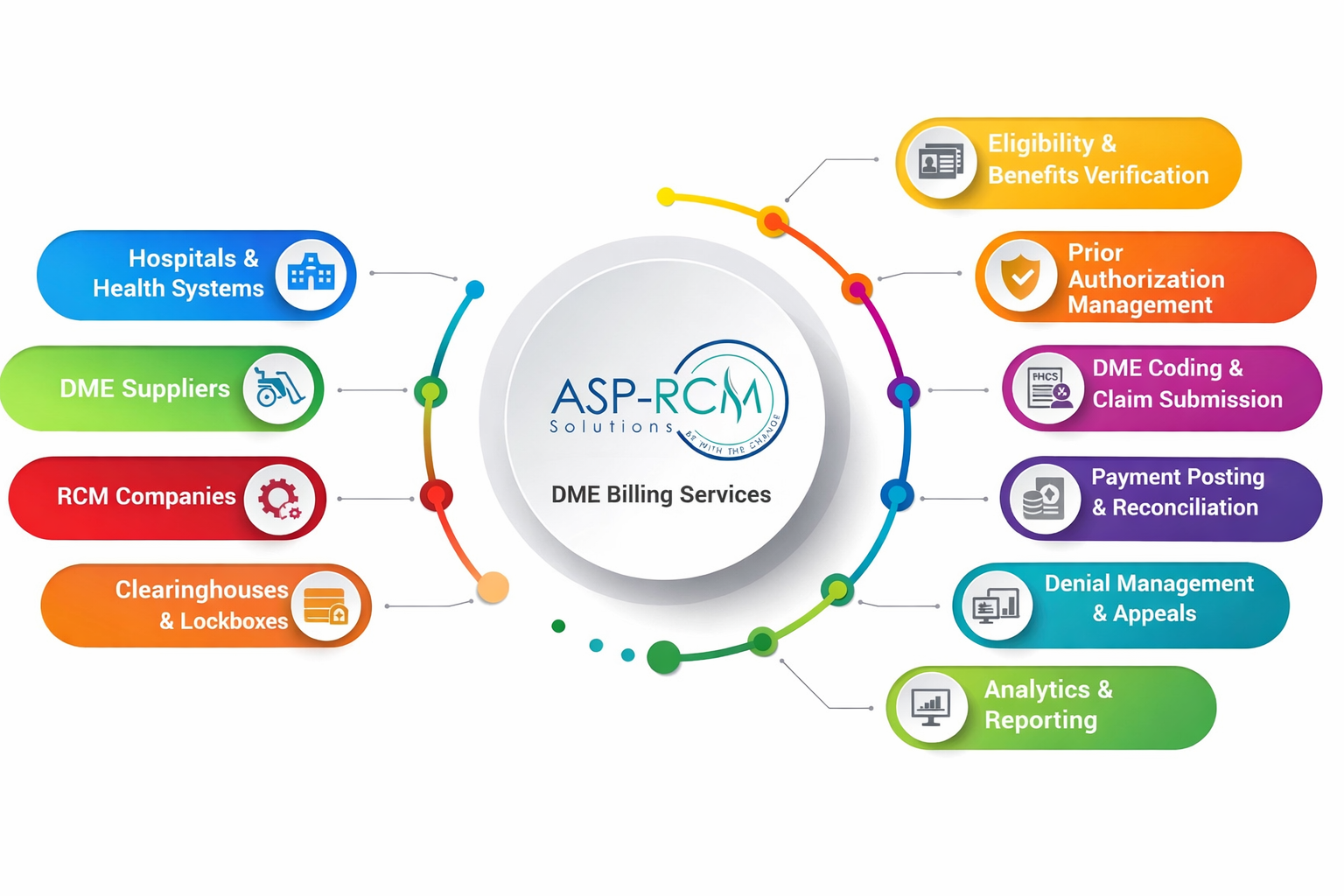
DME Billing Solutions: A Complete Guide to Improving Revenue Cycle Performance
By ASPRCM Solutions
Durable Medical Equipment (DME) billing is one of the most specialized and complex areas within healthcare revenue cycle management. Unlike traditional medical billing, DME claims require strict compliance with payer guidelines, proper HCPCS coding, accurate documentation, and continuous follow-up to ensure timely reimbursement. Even minor errors can lead to denials, delayed payments, and revenue loss.
This is where ASPRCM Solutions provides expert-driven DME billing solutions designed to optimize claims processing, reduce denials, and improve cash flow for healthcare providers across the United States.
What is DME Billing?
DME billing refers to the process of submitting insurance claims for durable medical equipment prescribed for patient use. These items are typically used for medical purposes, can withstand repeated use, and are appropriate for home use.
Common DME items include:
-
Wheelchairs and mobility aids
-
Oxygen equipment
-
CPAP and BiPAP machines
-
Hospital beds
-
Nebulizers
-
Blood glucose monitors
Unlike standard physician billing, DME billing involves rental and purchase models, capped rentals, maintenance fees, and strict Medicare documentation requirements. Because of this complexity, many providers struggle to maintain consistent revenue without specialized billing support.
Key Challenges in DME Billing
Healthcare providers often face several obstacles in DME billing operations:
1. Complex HCPCS Coding
DME claims require accurate HCPCS (Healthcare Common Procedure Coding System) codes along with appropriate modifiers. Incorrect coding can result in immediate claim rejection.
2. Documentation Requirements
Payers, especially Medicare, require detailed documentation such as:
-
Physician orders
-
Proof of delivery
-
Medical necessity documentation
-
Face-to-face encounter notes
Missing or incomplete documentation leads to denials.
3. Prior Authorization Delays
Many commercial payers require prior authorization before equipment delivery. Delays in approvals directly affect revenue flow.
4. Frequent Claim Denials
DME claims are more frequently denied compared to standard medical claims due to strict compliance rules.
5. Accounts Receivable (AR) Management
Unpaid claims require aggressive follow-up to prevent aging AR and revenue leakage.
Without an experienced billing partner, these challenges can significantly impact financial stability.
How ASPRCM Solutions Strengthens DME Billing Performance
ASPRCM Solutions offers end-to-end DME billing services tailored specifically for DME suppliers, healthcare providers, and medical equipment companies.
Accurate Coding and Claim Submission
Our team ensures precise HCPCS coding and modifier application to maximize clean claim rates and minimize rejections.
Complete Documentation Verification
Before claim submission, our experts verify all required documentation to ensure compliance with Medicare and commercial payer policies.
Prior Authorization Management
We handle authorization workflows efficiently to prevent delays and avoid claim denials.
Denial Management and Appeals
Our denial management specialists analyze root causes and submit timely appeals to recover lost revenue.
AR Follow-Up and Revenue Optimization
We proactively track unpaid claims and conduct regular follow-ups with insurance carriers to reduce AR days and improve collections.
Benefits of Outsourcing DME Billing to ASPRCM Solutions
Partnering with ASPRCM Solutions provides measurable benefits, including:
-
Improved clean claim rates
-
Reduced denial percentage
-
Faster reimbursements
-
Better cash flow management
-
Compliance with CMS and payer regulations
-
Transparent performance reporting
By outsourcing DME billing to a specialized RCM company, providers can focus on patient care while experts handle the complexities of reimbursement.
Why DME Billing Requires Specialized Expertise
DME billing is not just about submitting claims. It requires:
-
Continuous monitoring of Medicare updates
-
Understanding rental vs. purchase billing cycles
-
Correct use of modifiers such as RR, NU, and UE
-
Proper coordination of benefits
-
Audit readiness and compliance documentation
A small mistake in modifier usage or documentation can delay payments for weeks or even months. That is why having a knowledgeable DME billing partner is critical for sustainable revenue growth.
Technology-Driven Approach
ASPRCM Solutions leverages advanced billing software and analytics tools to:
-
Track claim status in real time
-
Identify denial trends
-
Monitor payer performance
-
Generate customized financial reports
This data-driven approach enables healthcare providers to make informed business decisions and continuously improve revenue cycle efficiency.